Measurement of the insulation resistance of the windings of power transformers
 Insulation resistance of the windings of power transformers parallel branches are produced between the branches, if in this case the parallel branches can be divided into electrically unrelated circuits without soldering the ends.
It is recommended to measure the insulation resistance of the power transformers beforehand measuring the dielectric loss tangent and the capacitance of the coils.
Measurement of the insulation resistance of the transformer windings is made with a megohmmeter between each winding and the case (ground) and between the windings with the remaining windings disconnected and grounded to the case.
The state of insulation of power transformers is characterized not only by the absolute value of the insulation resistance, which depends on the dimensions of the transformers and the materials used in it, but also absorption coefficient (the ratio of the insulation resistance measured twice — 15 and 60 s after applying the voltage to the test object, R6o «and R15»).It is allowed to take it as a starting point start of rotation of the handle of the megohmmeter.
Before starting each measurement according to fig. 1, the coil under test must be grounded for at least 2 minutes. The insulation resistance R6o «- is not standardized, and the indicator in this case is its comparison with the data from the factory or previous tests. The absorption coefficient is also not standardized, but is taken into account when considering the measurement results.
Usually, at a temperature of 10 — 30 ° C for non-moistened transformers, it is within the following limits: for transformers less than 10,000 kVA with a voltage of 35 kV and lower — 1.3, and for transformers 110 kV and higher — 1 .5 — 2. For transformers wetted or with local defects in the insulation, the absorption coefficient approaches 1.
Due to the fact that during acceptance tests it is necessary to measure transformers at different insulation temperatures, it should be taken into account that the value of the coefficient changes with temperature. Addition Kabc = R6o » / R15 «- shown in fig.2.
In order to compare the insulation resistance, it is necessary to measure it at the same temperature and indicate the temperature at which the measurement was made in the test report. When comparing, the results of insulation resistance measurements at different temperatures can be reduced to the same temperature, taking into account the fact that for every 10 ° C the temperature drop R6o «increases by about 1.5 times.
The instructions in this regard give the following recommendations: the value of R6o «must be reduced to the measurement temperature specified in the factory passport, it must be: for 110 kV transformers — at least 70%, for 220 kV transformers — at least 85 % of the value indicated in the passport of the transformer.
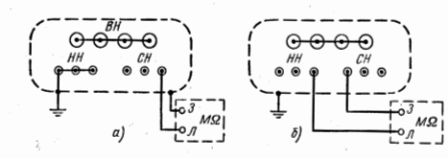
Rice. 1. Schemes for measuring the insulation resistance of the transformer windings: a — relative to the casing; b — between the windings of the transformer
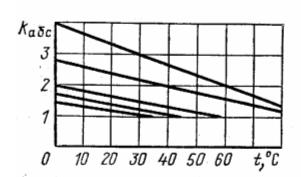
Rice. 2 Addiction Cabc = R6o » / R15 «
The insulation resistance of bushings with oil paper insulation is measured with a megohmmeter for a voltage of 1000 — 2500 V. In this case, the resistance of the additional insulation of the bushings is measured against the connecting bushing, which must be at least 1000 megohms at a temperature of 10 — 30 ° C. The primary insulation resistance of the transformer bushing must be at least 10,000 megohms.